
Engineers who start with AI image analysis often first look for the fastest route to image data. Connect a camera, acquire images in Python, OpenCV or an AI framework, and then test whether a model can recognise products, parts or defects. In this first phase, the difference between an industrial UVC camera and a machine vision camera may seem small. After all, both deliver image data to a computer.
The real difference appears when the project moves beyond the first test. At that point, the question is no longer simply whether an image is available, but how much control the system has over that image. This is especially important in AI, because a model can only learn and make reliable decisions when the image input remains consistent. Variation in lighting, colour, sharpness, compression or timing can cause the model to learn not only the product, but also accidental changes in the imaging chain.
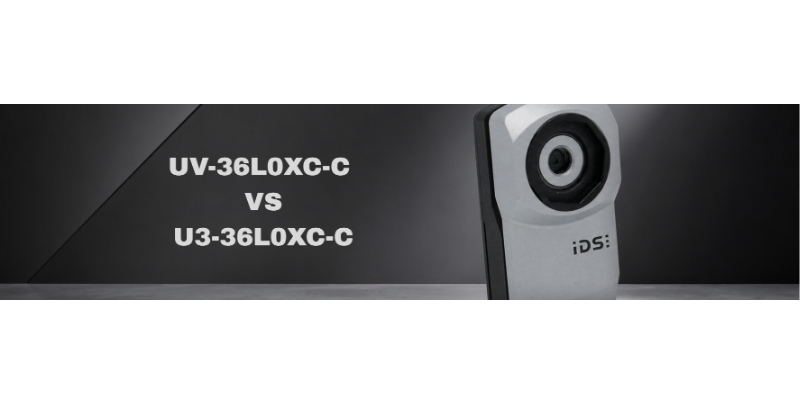
With a standard consumer webcam, the sensor, lens and mechanical robustness often become limiting factors quite early. With the IDS UV-36L0XC-C, this is different. This camera is not a standard consumer webcam, but an industrial UVC camera in a robust design. That is exactly why it is a useful example: the comparison is not between a cheap webcam and an industrial camera, but between two industrial camera solutions where the main difference lies in the interface and integration philosophy.
The industrial UVC camera: plug and play image acquisition via a webcam interface
The IDS UV-36L0XC-C is interesting because it behaves like a webcam from the system’s point of view, while the camera itself is built for industrial use. Via the USB Video Class interface, the operating system immediately recognises the camera as a camera device. In many software environments, it is therefore available as a plug and play video source, for example with a YUV stream.
This makes the camera a strong choice for applications where fast integration is more important than full machine vision control. An engineer does not first have to set up a GenICam acquisition layer or a specific SDK integration. The camera appears as a standard camera source, which makes it quickly usable for AI tests, laboratory setups, kiosk applications, robot monitoring, documentation or visual support.
In this specific example, it is important not to describe the UV version as “just a webcam”. That would be technically misleading. The IDS UV-36L0XC-C has an industrial foundation, with a robust housing, integrated lens and a sensor solution suitable for industrial applications. The webcam like aspect mainly lies in the way the camera is addressed by the system.
The machine vision camera: controlled acquisition via GenICam or IDS peak
The IDS U3-36L0XC-C uses the same practical basic design, but is integrated in a different way. This camera is not primarily used as a standard webcam source, but fits into a machine vision workflow via GenICam or IDS peak. This changes the role of the camera. It is no longer just a video source, but a controlled part of an image acquisition system.
That difference matters when the image is used for inspection, measurement, classification or process decisions. In such a system, settings must be reproducible. Exposure, gain, image format, acquisition behaviour and software integration should not simply happen to be correct during a test, but must remain predictable when the system restarts, runs on another PC or is used in a production environment.
For AI applications, this level of control is often more important than it first appears. An AI model may look robust during a proof of concept, but later become unstable when the image input changes. If the camera interface mainly works as a general video stream, it becomes harder to manage the complete imaging chain as a measurement process. A machine vision interface gives the engineer more control over acquisition and therefore over the quality of the dataset.
The difference is not simply good camera versus bad camera
In many comparisons between webcams and machine vision cameras, the difference is explained mainly through hardware quality. A standard webcam often has a simple lens, limited mechanical stability, automatic image corrections and few industrial connection options. That is true in many situations, but it is not the core of this comparison.
What makes the IDS UV-36L0XC-C and IDS U3-36L0XC-C interesting is that their hardware foundation is strongly comparable. This makes the practical difference much clearer: the real distinction lies in the interface, the software control and the level of control over image acquisition.
The UV version is the logical choice when plug and play behaviour is important. The U3 version is the logical choice when reproducible image acquisition is more important than direct recognition as a webcam. One is not automatically better than the other. The right choice depends on the role of the camera in the system.
Why this is especially relevant for engineers starting with AI
Many AI projects start with a simple question: can the model see the difference? In that phase, an industrial UVC camera is attractive. The camera is quickly available in the software, the first dataset can be built up quickly and the engineer can focus on the model instead of on camera integration.
But as soon as the project moves towards production or repeatable quality control, the question changes. It is no longer only about recognition under test conditions, but about stable recognition with varying products, batches, lighting conditions, positions and cycle times. At that point, the camera becomes part of the measurement system.
An AI model cannot easily compensate for an unstable imaging chain. If the image input changes because of automatic corrections, changing stream settings or limited control over acquisition parameters, fault analysis becomes more difficult. Was an incorrect classification caused by the product, the lighting, the lens, the camera setting, the stream or the model itself? The less control there is over image acquisition, the harder that diagnosis becomes.
The camera must fit the rest of the vision system
Choosing a camera based on interface alone is not enough. The camera remains part of a complete imaging chain. The sensor and lens determine how much detail is technically available, but the lighting determines whether the relevant product feature becomes visible with stable contrast. The interface then determines how controllably that image information is transferred to the software.
For a simple AI test, an industrial webcam like camera may be sufficient. But when products are moving, lighting is triggered, exposure time must be short or multiple cameras must work reproducibly, the system architecture becomes more important. The camera must then work together with lighting, lens, mounting, software and industrial PC. In that case, a machine vision camera is usually the better fit.
That is why it makes sense not to start the decision with “webcam or machine vision camera”, but with the application. If the image mainly has to be viewed or analysed quickly, the UV version can be an efficient choice. If the image becomes the basis for controlled inspection or AI decisions, the U3 version becomes the more logical option.
When should you choose an industrial UVC camera?
The IDS UV-36L0XC-C is a good fit when simple integration is the most important design criterion. The camera is immediately recognised by the system as a camera and can be used as a standard video source. This reduces integration costs and speeds up the first test phase.
This is especially valuable for AI prototypes, laboratory setups, documentation, diagnostic images, kiosk applications and robot monitoring. In these situations, it is often more important to have reliable image data available quickly than to manage every acquisition parameter through a machine vision interface.
The limitation only appears when the same camera is used for an application that actually requires reproducible image acquisition. In that case, the simple start may later lead to extra integration work, because the imaging chain still needs to be controlled more tightly.
When should you choose a machine vision camera?
The IDS U3-36L0XC-C is a better fit when the camera becomes part of a controlled vision or AI system. Via GenICam or IDS peak, the camera can be integrated into a workflow where image acquisition, settings and software control are central.
This is important for automatic inspection, defect detection, dimensional measurement, code reading, robot guidance and AI classification in a production environment. In such applications, an image is not just a visual stream, but measurement data. The camera must not only provide an image, but make that image available in a reproducible way.
For engineers, this means that the U3 version is usually the safer choice when the project has to scale from testing to production. Not because the UV version is not an industrial camera, but because the machine vision interface is a better match for controlled acquisition. Engineers who want to build the complete camera selection around application, resolution, field of view, lighting and interface can continue reading in our machine vision camera selection guide.
Practical conclusion
The comparison between the IDS UV-36L0XC-C and the IDS U3-36L0XC-C shows clearly that the difference between an industrial UVC camera and a machine vision camera is not always found in the sensor, lens or housing. In this case, the main difference lies in the interface and the way the camera is used within the system.
The UV version is an industrial camera that behaves like a webcam. This makes it strong for plug and play integration, fast AI testing and applications where a standard video stream is sufficient. The U3 version is the machine vision version, better suited to GenICam, IDS peak and controlled image acquisition.
For engineers starting with AI, this distinction is important. A fast start with a webcam interface can be very useful, but when scaling towards reliable inspection, the imaging chain must be reviewed again. AI performance does not depend only on the model, but also on the stability of the camera, lighting, lens, interface and software integration.
The right choice is therefore not a general choice between “webcam” and “machine vision camera”. The right choice depends on how much control the system needs over the image data. As soon as reproducibility, analysability and production reliability become important, the decision usually shifts towards a true machine vision interface.