

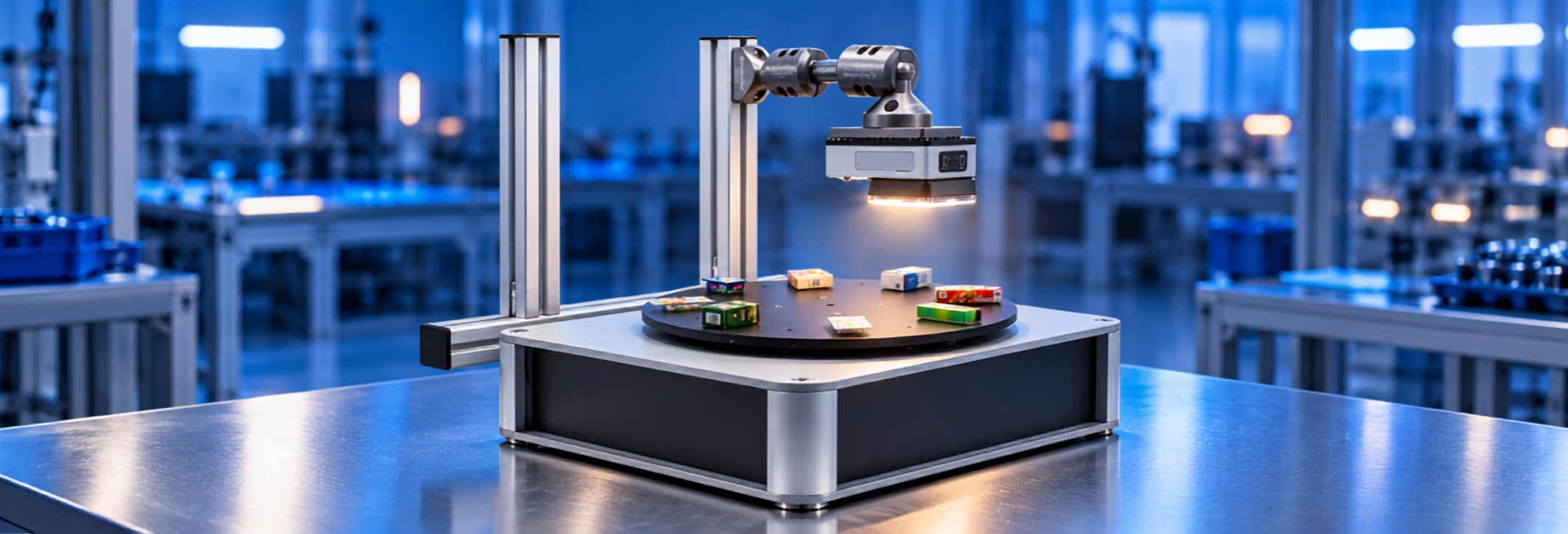
A turntable is often used at machine vision exhibitions and demonstrations. There is a good reason for this. By mounting several products on a rotating disc, an inspection can run continuously without the need for a complete conveyor system. Good and rejected products repeatedly pass the camera, making it easy to demonstrate what the application does and at what speed the inspection is running.
We also use turntables at exhibitions, but in practice we use them even more during the development and testing of machine vision applications. They are particularly useful when testing communication with a PLC, evaluating an application at production speed or preparing a system for a FAT.
Testing before the production line is available
A machine vision application consists of more than just a camera and image processing software. The camera has to be triggered at the right moment, the image must be sharp, processing has to be completed within the available cycle time and the inspection result must then be communicated correctly to the PLC.
During development, the final production line is often not yet available. Even so, it is useful to test as much of this sequence as possible beforehand.
With a turntable, products can continuously pass the same inspection position. The speed can be adjusted, so we can test not only whether the inspection works, but also whether it remains reliable at the required production speed.
This is particularly useful when testing PLC communication. At low speed, almost any communication sequence appears to work correctly. Timing problems usually become visible when products start following each other more quickly. A trigger may arrive too early or too late, an inspection result may not yet be available, or the pass/fail signal may no longer fit correctly within the available cycle time.
A turntable allows us to repeat these situations continuously without having to place products in front of the camera by hand. We can gradually increase the speed and see how the camera, software and PLC behave together.
Inspection speed is more than processing time
When testing inspection speed, the first parameter people often look at is the processing time of the vision software. That is important, but it is only part of the complete process.
The product is moving while the image is being captured. This means that the exposure time must be short enough to produce a sharp image. At the same time, the machine vision lighting must provide enough light to maintain sufficient contrast at this shorter exposure time.
By increasing the speed of the turntable, we can determine where the practical limit of the application lies. This is not only the limit of the software, but of the complete combination of camera, lighting, triggering and communication.
With a correctly designed setup, the image should remain sharp and have sufficient contrast even at higher speeds, without motion blur or pixel smear affecting the inspection. At the same time, there must still be enough time to process the image and communicate the result.
This combination is difficult to evaluate properly when testing only with stationary products. In our article on motion blur, exposure time and pixel smear, we look in more detail at the relationship between product speed, pixel resolution, exposure time and strobe lighting.
A practical setup for FAT
For machine builders and system integrators, the same approach can also be used during a Factory Acceptance Test (FAT).
When a vision system has to be accepted before it is installed in the final machine, the actual product movement is often missing. A turntable makes it possible to simulate an important part of these operating conditions.
If an application has to achieve a specified production speed, representative products can be mounted on the turntable and moved past the camera at that speed. We prefer not to test exactly at the required limit, but also at a slightly higher speed, for example 10% above the specified production rate.
This makes it possible to demonstrate that there is some margin in the application.
During this type of test, it becomes immediately clear whether the camera still produces a sharp image at the required speed, whether the lighting provides sufficient contrast and whether the inspection remains within the available cycle time. When the PLC is connected as well, the communication for good and rejected products can be tested at the same time.
A turntable does not replace every test on the final machine. A real conveyor can introduce different vibrations, product positions or product movements. However, a large part of the vision software, triggering and communication can already be tested before the system reaches the production line.
This helps prevent these issues from being discovered for the first time during commissioning.
Also useful for hands-on machine vision training
We use the same principle within our Machine Vision Academy and during our hands-on training courses.
When explaining exposure time or motion blur, the subject remains relatively theoretical as long as the product is stationary. As soon as the product actually starts moving, the effect becomes much easier to see.
Participants can first build an inspection at low speed and then gradually increase the speed of the turntable. At some point it becomes clear that the exposure time is too long, that more light is required or that processing time is beginning to limit the application.
A PLC can then be added to the setup. Step by step, this creates a small but realistic machine vision application in which camera, lighting, triggering, software and machine control all have to work together.
For us, this is one of the main advantages of such a test setup. The objective is not only to see whether a vision tool produces the correct result, but to understand and test the complete application. We use the same practical approach during our On-Site 2D Machine Vision Application Training.
Our tabletop machine vision turntable
Because we use this method regularly, we have further developed our tabletop turntable specifically for machine vision applications.
The setup can be used with one or two smart cameras, as well as with industrial GigE or USB cameras. A 24 VDC power supply, trigger sensor, network switch and motor controller are integrated into the unit.
The rotating disc has sixteen positions where products or test pieces can be mounted. This makes it possible to run different good and rejected products through the same continuous inspection cycle.
This is useful for an exhibition demonstration, but for us its main value is during development and testing. We can build an application, run it at different speeds, test communication with a PLC and complete a substantial part of the validation before the final production line is available.
This makes the turntable less of a demonstration device and more of a practical engineering tool for developing and testing machine vision applications.
A compact turntable for machine vision testing and demonstrations
The tabletop turntable is also available for machine builders, system integrators, OEMs and engineers who want to develop, test or demonstrate their own machine vision applications.
Would you like more information about the configuration and technical possibilities? Contact us.
Do it yourself. But not alone.